All posts by Dana

I was born in East Orange, raised in Bloomfield, and went to school somewhere around Newark until my parents launched an exodus across NJ. I have been lucky enough to travel abroad. I read, play a couple of musical instruments, like movies, and do what I can to improve a rapidly aging body and mind. I currently work in Texas and live in Florida. I have moved over two dozen times in my life. My tiny armies and navies have followed me on my march across the US. Eventually we hope to end our nomadic existence and settle in one place.

Baueda

A selection of Baueda scenic items, mostly tents

A company I have heard of only recently, they produce 15mm historical figures mostly ancients and middle ages from what I could see on their webpage.  They also offer 28mm fantasy football teams.  But where they really seem to take off is with their resin buildings and terrain pieces.

One of the curiosities that appeared in the WRG DBA rules was a rule mandated camps for each army.  The camp was inordinately large and was settled off on the edge of the board.  It could be as simple as a flat piece of cardboard or as elaborate as anyone could make.  I suspect that elaborate camps are the norm as DBA lends itself well to people who enjoy collecting figures and displaying them rather than simply gaming.

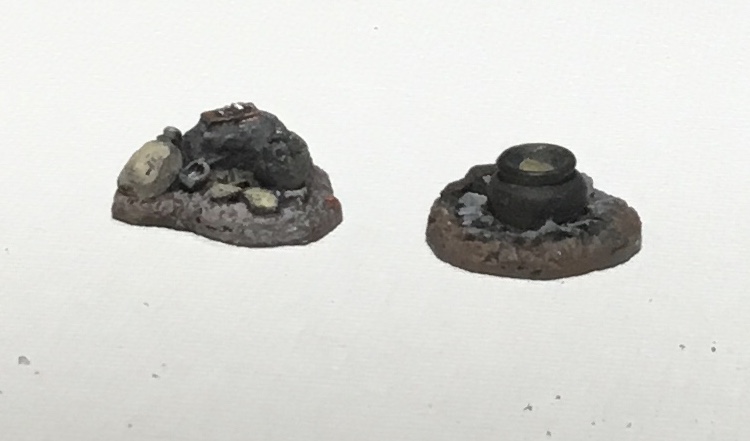
Baueda excels in offering an ever-widening range of camp tents, fortifications, and accessories to flesh out even the simplest camp.  They offer tents from Greek to Egyptian to Arabic as well as a variety of detail pieces for dressing a camp, most recently, a series of 4 outdoor cooking scenes.  For the lazy gamer (me) who can never seem to find the time to sit down and sculpt this stuff,  the Baueda pieces are a great help.

Because Baueda is based in Italy, it is likely that most of us will have to purchase through an intermediary.  Scale Creep seems to carry a lot of Baueda stock at the moment.  Baueda pieces also show up on E-bay sometimes discounted.  Otherwise, a list of dealers is available on the ;Baueda website.

Diminishing Returns

I seem to find myself involved in discussions that seem more and more pointless, meeting people that do not interest me, and finding myself in less and less attractive situations.  I comfort myself with the belief that such things are cyclic but find myself wondering if I am caught in a broader cycle that is tending in a negative direction.

I am clearing out trash in the apartment.  It is amazing how many worthless bits of nothing gather together and conspire to have themselves placed in a box with more or less worthless bits of nothing and then travel with me from place to place.  Perhaps that is the essence of collecting.

I have noticed that if I paint figures an hour or two each night (an impossibility given my current situation), I would likely get everything nicely painted in a couple of months.  I have noticed that it is nicer to look at photos of current work than older.  I suppose I will see where things stand in a couple of months if I am still here to check.

Bireme and Galley

A pretty old set of rules produced by Fantasy Games Unlimited, the set can be played with either miniature galleys or a series of cutout counters for a variety of different vessels.  There is also a large map showing a couple of basic oared vessels for staging man-to-man combat during boarding actions.  The map and one of the counters can be seen in the photo above.

For what it covers, the rules offer a fair amount of information and appear to be usable for all oared naval actions from ancient to encounters during the Renaissance.  The rules were likely meant for historical gaming but appear to offer enough detail to allow their use in RPGs.

One thing to make note of is that a clear overlay is provided with the rules for determining such things as turn radius for ships so if purchasing the set used which I assume is the only way to get it these days, make sure the overlay is included.


Jack Scruby

Jack Scruby was one of the pioneers of American wargaming providing a miniatures across a wide range of scales and historical periods. Scruby used RTV molds made of silicon rubber which allowed some level of undercutting on figure sculpts, something not possible using molds made of metal. He offered a well printed catalog and sold figures for a nominal price either by mail or through his store.

Additionally, he wrote a number of rules sets, edited and published several magazines on miniatures gaming, organized a club, as well as one of the first miniatures wargaming conventions ever held.

The figures seem relatively uncommon on E-bay and are probably interesting as much for the collector as the gamer. The figures I have seen are reasonably well proportioned with a toy-like appearance. There is little surface detail and just the simple outlines of face, hands, and equipment. Surface detail is lacking. Nevertheless, figures are reasonably proportioned. There is no sense of gnomishness.

I imagine that at the prices he sold these at, there are a lot out there, likely tucked away in boxes. They are one of the oldest wargaming figure sets made in the US.

Jack Scruby British Colonial 30mm

Back in the 50s and 60s, the perfect scale 30mm which in the end never really caught on except in a back handed fashion when 25mm transformed into 28mm.

The Scruby figures are pretty simple and rather plain.  They have a toy-like appearance and the poses seem a bit stiff but overall they are respectable figures.  There is not much surface detail but enough to allow a reasonable paint job especially on figures this large.

One thing that should be apparent is that Jack Scruby offered a lot of historical ranges in a lot of different scales.

Valiant 16th Century Ships

Valiant had during the 70s focused on naval vessels including a range of space ships for wargaming.  This is a selection of 1/1200 ships from their Spanish Main range.  The ships are highly detailed as one would expect for this scale.  Ships appeared to be either British or Spanish with some generic vessels and a galleass with either square or lanteen rigged sails.  The galleys available appear to have been part of the smaller scale Napoleonic range and sadly did not match the ornate galleass.

Though quite old, it appears that the Valiant molds are still in use and these ships can usually be found on E-Bay.  The ships are sturdy and put up with a reasonable amount of abuse except for the foremasts which have a tendency to topple with the slightest pressure.  These are good for Armada  games, piracy on the Spanish Main and similar things.

Archive Miniatures Middle Earth Army

Archive Miniatures short but productive run produced a range of interesting figures starting off with an historical range but gradually ebbing into fantasy and science fiction RPG figures.  Their Middle Earth range offered an entertaining take on the forces of evil.

The figures are immediately recognizable as Archive products through their octagonal base but also through the humor and detail in the figures.  The lower orcan army as they are listed in Archive catalogs have an undersized torso with large Mickey Mouse shoes and big dinosaur like heads.  They will likely inspire the most jaded figure painter with their combination of whimsy and menace.

This also demonstrates one of the hazards of collecting miniatures as the figures were available for a relatively short time as Archive Miniatures became only sporadically available after this offering.  Happily, I have more of these on hand not yet painted but of course it would be nice if the molds were still producing.  These offer a nice alternative to the more somber offerings of other companies.

Perry Miniatures


Perry Brothers long associated with Games Workshop present a shift to historical miniatures. Given the experience of Games Workshop, it is not surprising to find that Perry Brothers produces both plastic and metal figures. The unforgiving nature of 2-piece molds in injection molding precludes any undercuts so the plastic figures show marginal detail along the mold lines. But as one would expect, the price is significantly lower per figure than comparable metal figures.

The Perry brothers, Alan and Michael, have considerable experience in the hobby and an understanding of the needs of historical gaming. As with so many British sculptors, they appear to have an enthusiasm for the English Civil War, the Napoleonic Wars, and the American Civil War. They have also provided illustrations for Osprey publications.

I am currently using these to flesh out the Confederate forces as opposition to the metal Union figures. The quality seems good enough though the light weight takes some getting used to. Hats and some accessories are cast separately on the plastic figures which affords some useful variation in addition to a well thought out range of poses.

Corvus Belli

img_2050
img_2051
An interesting selection of figures, the ones I have bumped into seem to encompass a range covering the late Middle Ages. I purchased several packs because I wanted some billmen and thought it might be fun to break away from the Essex miniatures I have been using. The figures are 15mm and show what is often described as a ‘gnomish’ appearance with a shortened but bulky torso and little or no neck. With a reasonable paint job, they still look fine.

Beyond this, there seems little information on the company available other than that they are located in Spain. Several sites suggest that the historical line of miniatures has been discontinued and they now focus production on figures related to the game Infinity. I suspect that bags of these will still turn up occasionally though their ranges seem well covered by other manufacturers.

Charles Stadden

img_2054
img_2055
One of the older manufacturers, Charles Stadden was a WWII veteran who having left the service, took an interest in the military history of Great Britain and began producing a range of figures and illustrations of the military with an emphasis on Britain’s colonies. Stadden went on to work in a variety of scales for wargaming including 30mm, 25mm, and 20mm. The 20mm figures offer a good match to plastic figures.

Stadden appears to have carved his masters from some suitable material, perhaps plaster or jeweler’s wax. This give the figures a different look with flat areas along the figure surface where a knife was used. One could readily appreciate the patience involved. Even so, the figures look very lifelike with excellent proportions. Stadden’s figures never look lifeless. There is a repetition of poses with new heads and details.